How, as a designer, might you care for the land?
If you’re me, you write blog posts telling people it’s a good thing to do. If you’re the design researcher Gizem Oktay, you get practically involved in the aftermath of two massive earthquakes in Turkey that claimed 58,000 lives. Arriving on site, Oktay witnessed debris and wreckage containing medical and toxic waste being dumped into agricultural fields, wetlands, freshwater sources. The pressure on emergency responses to the earthquake was for quick results. There was no time to consider the impact on microorganisms.of dumping waste on soils and wetlands. But the consequences down the line, for human and more-than-human life would be profound. Rather than criticise from the sidelines, Oktay decided to explore whether practical alternatives, and especially bioremediation, could be a better approach than dumping to deal with waste and toxic contamination.
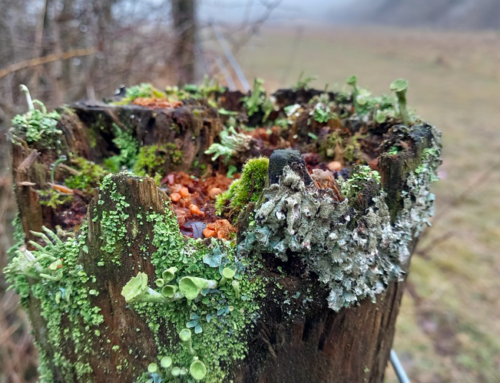
Bioremediation is a family of approaches that involve plants (phytoremediation); fungi (imycoremediation) and microorganisms such as bacteria (probiotic landscapes). Placing mycelium spawn (the living network of fungi) in a designated place, for example, can remediate contaminants by reading enzymes that break down complex molecules into simpler compounds that the soil can metabolise.
In an early experiment, Oktay writes: “Watching fungi grow on contaminated soil felt as what was once on the brink of death via destruction came to life with the aid of fungi”
At this point I half-expected a miracle to be described. Superhero fungi would eat up all those nasty toxins and replace them with teeming healthy soil.
Not so easy – and not so fast.
Oktay discovers that mycoremediation techniques developed in laboratories do not transfer easily to the ‘feral’ or living world. There, remediation depends on the times other beings need to operate in their own time, and on at their own pace and scale.
Mycelium, for example, does not grow to order. It grows according to conditions that are unique to each context: temperature, moisture, earthworms, termites, other insects, microorganisms, precipitation levels, and myriad other factors. Caring for the land involves attuning to these multiple rythms of a landscape.
These messy and complex contextual factors are carefully excluded from the sterile laboratory settings of industrial bioremediation research. Such labs aspire to achieve efficiency, precise outcomes – and above all, scale. This approach follows an industrial production logic. It must meet the needs of global markets and perpetual economic growth.It therefore assumes, for any promising organism or process, that its metabolic functions needs to be be accelerated. Think: genetic modified crops with higher yields; fish that grow faster and fatter; yeast that accelerate fermentation. Forcing biomaterials into productivist timelines also results in energy-intensive, highly processed materials.
Caring for soils, and indeed all living systems, means aligning with naturally occurring temporal patterns. It means developing patience for natural processes to unfold in their own times. It entails more complex ecological relationships than the timescales of industrial production.
Gizam Oktay, and this book’s other authors, aim to rediscover temporality and contextuality as positive qualities that industrial systems treat as inefficiencies.
This switch of focus from productivity to care is not – to put it mildly – a small change for design.
And not a fast one: social change on this scale takes time.
Think back to Copernicus. When he proved that the earth revolves around the sun, and not vice versa, it took a further 100 years of denial and resistance before the news really sunk in.
The same lesson on timescales goes for the crisis-ridden industrial economy we have today. The root cause of these polycrises. for John Michel Greer, is temporal-geological. We’ve burned our way through fossil fuels -that were formed by sunlight over millions of years – in a couple of hundred years. Greer describes the inevitable reckoning, that we are now in, as ’catabolic collapse’ . wiki.p2pfoundation.net/Catabolic_Collapse
The good news, here, is that we are not starting from scratch. A Copernican-style revolution in values – from productivism, to care – has been brewing for decades.
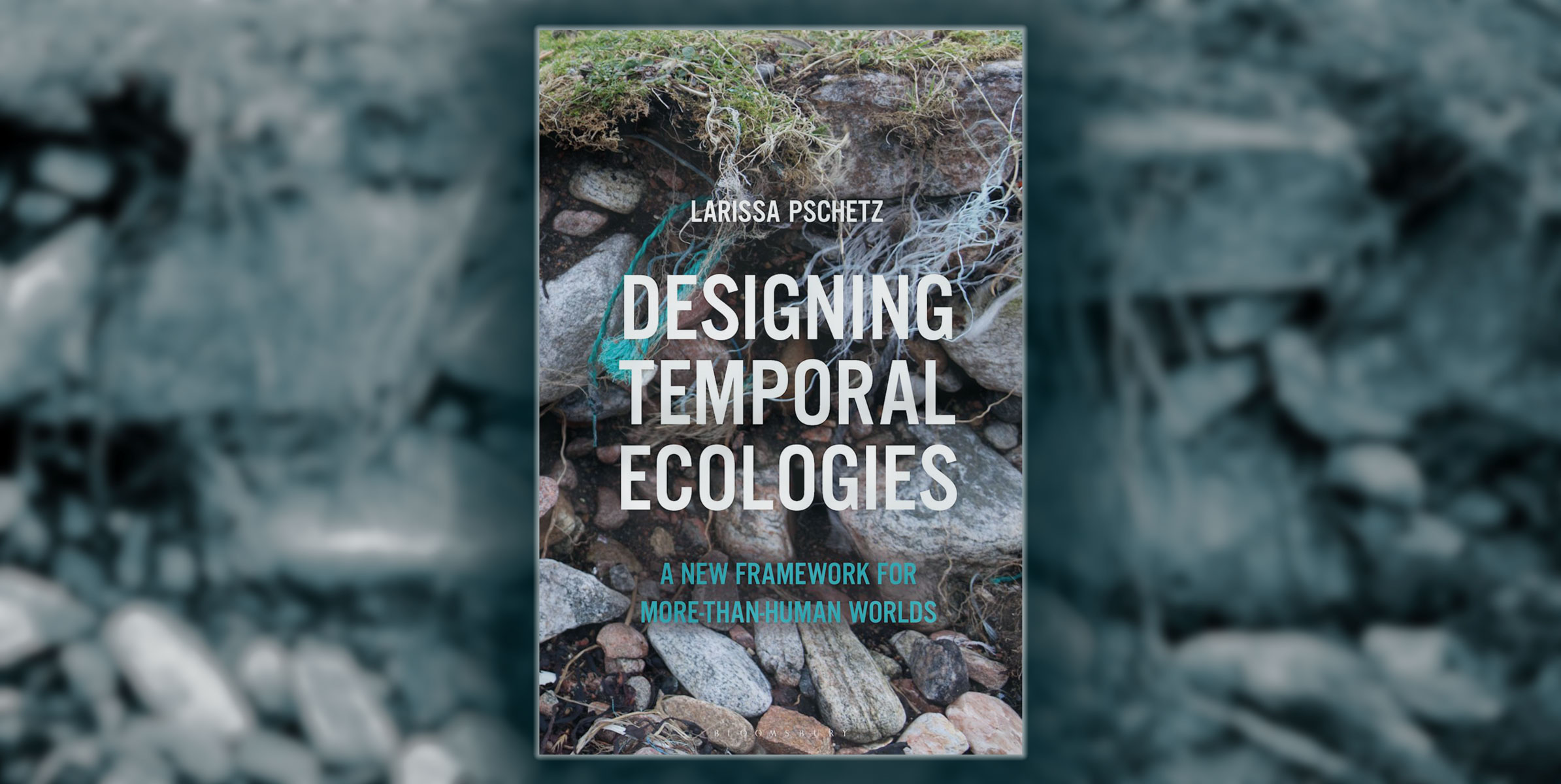
“We need to think about time as interdependent, co-created, and multiple” concludes the book’s editor, Larissa Pschetz. And not just think. Designing within temporal ecologies, at least in this book, is no longer just a wish. It’s beginning to happen all around us.
Designing Temporal Ecologies: A New Framework for More-than-Human Worlds,
edited by Larissa Pschetz
bloomsbury.com/uk/designing-temporal-ecologies-9781350522305/