As a young boy in 1960s Newcastle, it was always a drama in my house when Proctor & Gamble’s advertising whiz kids came to dinner.
My father, as P&G’s Chief Engineer, basically designed factories – but he was also curious about the consumer advertising that these clever ad men (they were all men) were pioneering. (This was not so long after the first ever television commercial was aired, in 1941)
I remember a furious exchange about a tv commercial for Fairy Liquid and its immortal line, “Mummy! Mummy! Why Are Your Hands So Soft” . The ad men at our dinner table pronounced it to be genius. My feminist mother, outraged, said it was completely amoral.
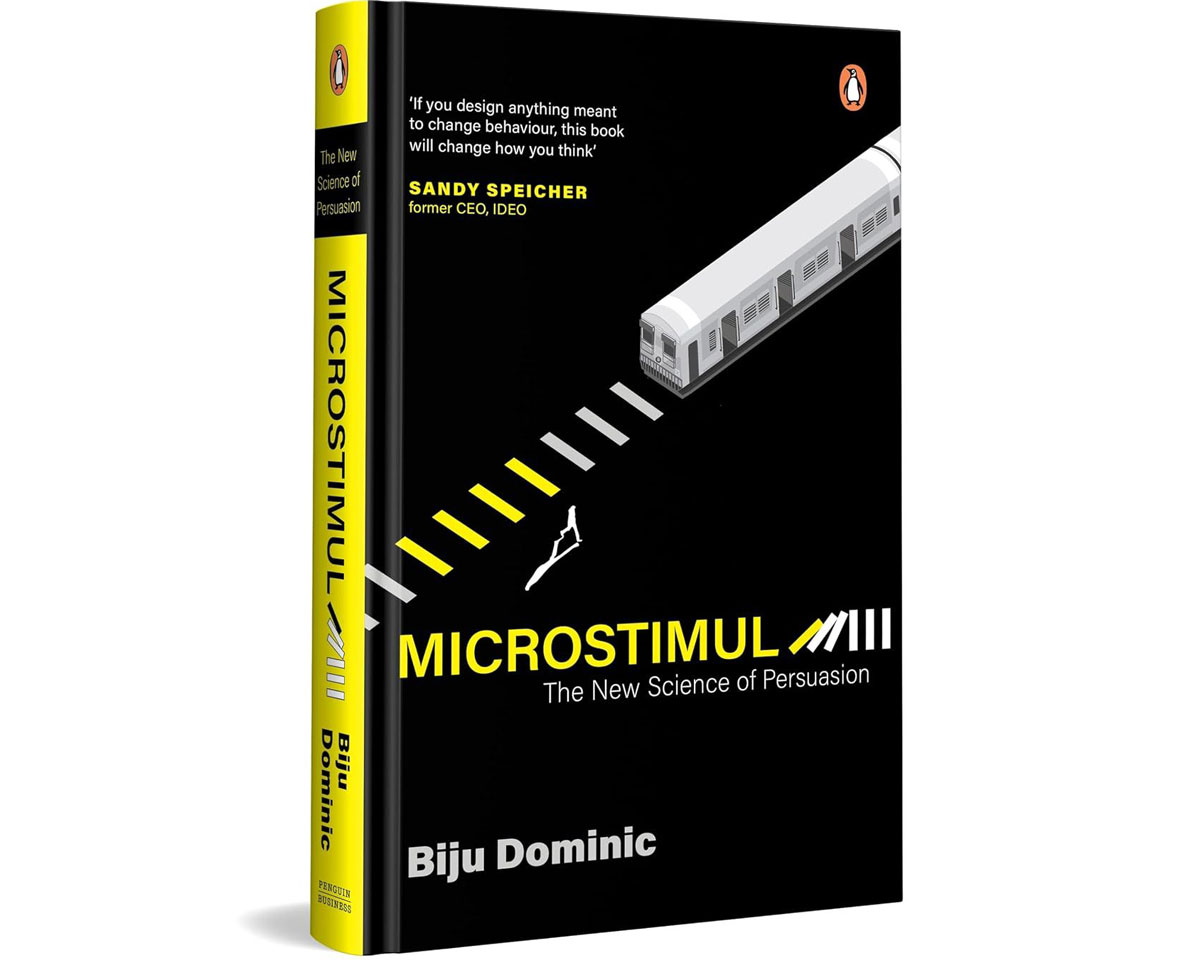
I was reminded of that moment when reading Biju Dominic’s MicroStimuli: The New Science Of Persuasion.
A startling and thought-provoking new book, it challenges a widely held assumption about human behaviour: that we think before we act. The book describes, in contrast, how most decisions are made non-consciously through fast emotion-driven processes that operate beneath awareness. Biju Dominic’s radical approach is to use MicroStimuli, measured in milliseconds, to change our behaviour.
Awareness-action gap.
The promise of MicroStimuli, which grabbed my attention, was of “powerful solutions to the world’s most persistent challenges”.
One challenge in particular has preoccupied me for all my adult life: the dire condition of life on earth. Might MicroStimuli be the solution we need to help us fix the planet’s social and ecological systems?
Along with millions of fellow environmental campaigners, I had long assumed that that providing stronger arguments, and harder evidence, would change how people acted.
That approach failed. Yes, we raised the world’s awareness. But – in the absence of telling people what to do with this terrifying information – we also created widespread fear and anxiety along the way.
Biju Dominic calls this the awareness-action gap – and he has developed MicroStimuli as a way to close it.
Drawing on insights from neuroscience, artificial intelligence, consumer research, and design, MicroStimuli are nonconscious persuasive stimuli—tiny precision triggers – deployed in the final moment, often milliseconds, before an action. They activate the brain’s fastest pathways to influence behaviour.
Because MicroStimuli speak directly to the non-conscious processing system, Biju reckons that they “bypass the logical aspects entirely”.
The context for the book is the global smartphone environment. With smartphones now constantly in our hand, and always connected, the old advertising model of reaching people during predictable moments, like while they watch television in the evening, is now obsolete
We look at our phones 4,500 times a day, usually for just a few moments each time. Ninety nine per cent of smartphone interactions last just a few fleeting moments. But the number of such moments is vast.
In today’s always-on, always-with-you smartphone-filled world, MicroStimuli can “prompt desired behaviours throughout the day”
MicroStimuli for public good
The book contains many admirable examples of MicroStimuli used successfully for public good.
The best-known of these, the Railway Trespassing project, aimed to prevent sixteen deaths per day among pedestrians crossing railway tracks illegally in Mumbai.
Years of effort to halt the carnage had been ineffective. Pedestrian bridges had been added. Warning signs proliferated at accident black spots. But the deaths continued.
Then, after weeks of patient observation, Biju’s team made a life-saving discovery. The human brain finds it hard to judge the incoming speed of a large object, such as a train, correctly.
Based on that insight, simple and inexpensive solutions then proved effective. When a few sleepers were painted yellow at regular intervals, the speed of approaching train could be judged more correctly from a distance. Changing locomotive horn patterns – fast/repetitive or staccato sequences – further increased the alertness of trespassers. Many lives were saved.
MicroStimuli that stop you stepping in front of a train is a public good, of course. The book contains other examples behaviours being changed in a positive way: non-adherence to medication; the health benefits of walking a little more; he need to drink enough water; getting proper sleep; driving more safely.
Biju Dominic is justifiably proud. “Leveraging non-conscious brain processes to shape behavior is the responsible application of modern neuroscience to improve lives around us”.
MicroStimuli for consumption
But a second class of “behavioural problems” addressed by MicroStimuli is less obviously, for me, a problem we need to solve. This is the failure of hundreds of millions of people to click ‘Buy” when shopping online.
Although global brands spend two trillion dollars a year on marketing, millions of consumers, when shopping online, do not make it past the awareness stage and actually click “Buy.” Even when we are aware of a product, and its benefits, a phenomenon called Cart Abandonment runs at a steady 70 per cent.
In 2025, around 18 billion online shopping carts were cruelly abandoned. With twenty to forty per cent of all retail sales now online, this means that transactions worth an astounding seven trillion dollars were begun, but never completed.
These numbers are impressive, but I’m troubled by a question: does it matter?
If Cart Abandonment means you do not buy something online that you may really not have needed – and whose production, sale and use impacts the planet negatively – in what sense is it a ‘problem’?
For the Argentine writer Jorge Alemán Lavigne, rampant overconsumption drives many of our biggest social and ecological problems. “Consumer society has turned us into atomised individuals whose task is not to support each other, but to consume” he writes. “Decades of deregulation and privatisation have cultivated insecurity, individualism and status anxiety – and on a a mass scale”.
Libidinal operators
Around the world, malign political actors are tapping into fears and anxieties fostered by life in consumer society. Lavigne describes these populist leaders as libidinal operators.
With a focus on those who feel powerless, libidinal operators channel the desire for exclusion of the Other. They then offer diverse ways to be nasty, vindictive and cruel towards those the most vulnerable.
To the millions among us who are socially isolated, they offer a sense of belonging, meaning, and self-esteem.
To those who feel fearful, they promise order and security – often by the use of force.
These negative social consequences – fear, insecurity, and isolation – are well known to global brands. After all, they study our states of mind obsessively – in order to sell us things. But despite these dire social consequences, they show no signs deviating from their market-fixated ways. They will continue to create new needs, and increase consumption, to the maximum extent possible.
And the explict promise of MicroStimuli? Help them do so with greater precision, and more effectively, than ever before.
A striking example in the book comes when Biju pitches for work at a major chocolate brand. He describes the three slides he presented to the high-level meeting. “On Slide One, we proposed approaching the problem from a neuroscience perspective. On Slide Two, we explained that chocolate, at its core, is glucose. And when glucose levels drop, our bodies instinctively seek replenishment. On Slide Three, we showed how identifying the moments when gluose dips – the real moments of glucose craving- could unlock the exact digital moments most suited for chocolate persuasion”.
Is an insufficiency of chocolate consumption one of the world’s most persistent behavioural challenges? I’m not convinced.
Does this make MicroStimuli unethical?
The author highlights that quandary when he asks, on the book’s first line: ’Is it ethical to influence someone’s behaviour without their conscious awareness?”
This question is not new. The world of marketing has long had the unconscious in its sights. Seventy years ago, Vance Packard’s The Hidden Persuaders dramatically raised public awareness of advertising, consumerism, and media manipulation. A worldwide media studies industry, born at that moment, now produces thousands of papers every year.
But growing public awareness did nothing to slow the industry down. On the contrary: according to Grok, when Hidden Persuaders was published in 1978, global marketing/advertising spend was in the range of $50–80 billion. Today, MicroStimuli is being pitched to an advertising economy that, at up to $2 trillion, is 40 times higher than when Hidden Persuaders came out.
Now you may well complain, at this point, that it’s unfair to blame MicroStimuli for the political dystopias now unfolding around the world. And I would have to agree. The capitalist system is to blame, not a pragmatic marketing technique.
Besides,casting blame is not just unfair, it’s ineffective
Ever since those ad men came to dinner when I was a boy, and I witnessed my mother’s appalled reaction, I’ve been sceptical that ad persons will ever turn down the opportunity to increase sales. Indeed, when I asked a marketing expert recently whether or not MicroStimuli are ethical, he replied, “I don’t know, but do they work?”
My point here? Moralistic finger-pointing does not create positive change. Making demands on business, or telling politicians what they must do, are also ineffective.“You must end this obsession with perpetual growth”. “The government must end our dependency on fossil fuels”.
They’ won’t, because they can’t. We all live within a system – capitalism – whose very essence, its basic operating system, is to stimulate consumption, invent new needs, and extract resources from the earth to meet them.
Changing awareness on its own cannot, and will not, change this system. Critique, without action, is a recipe for anxious introspection and debilitating climate guilt.
How positive change happens
After years of ineffective activism, I made a resolution to stop shouting that we must stop doing something (because it’s bad for life on earth, etc etc) without also, at that same moment, pointing to practical acts of care we can do, instead.
The good news is that millions of living alternatives to consumer society – and the means to change the system – are all around us. These millions of grassroots projects – some new, many more the descendants of historical practices – are the seedlings of a replacement for business-as-usual.
These practices are scattered, and for the most part unseen on the world’s smartphones – but they don’t have to be invented from scratch.
I maintain a collection of case study collections on my website. I have also written about 60 new kinds of jobs that you probably never heard of before, but that people are doing now.
Will these myriad small projects wash away capitalism like some giant green tsunami?
On their own, no, of course not. But they don’t have to.
The main reason we’re in a polycrisis now? An intense global debt-energy system has duly reached limits to growth that scientists have been warning us about for decades. The global system – the energy-intense, extractive, grow-to-infinity capitalist system – is degrading of its own accord. Its running up against biophysical forces that are beyond its or anyone else’s control.
Once all the infrastructures, networks and gadgets of modern life are factored in – the cars, planes, factories, buildings, infrastructure, heating, cooling, lighting, food, water, hospitals, information systems, and their attendant gadgets – well, a New Yorker or Londoner today ‘needs’ about 60 times more energy and resources, per person, than a hunter gatherer did, 10,000 years ago.
And these ‘needs’ are escalating. Think, data centres. Think, airconditioning for the masses.
To put it more personally: you and I use more energy & resources in a single month than our great-grandparents used during their whole lifetime – and we’re doing so on a finite planet.
It can’t, and won’t, persist.
Practical acts of care
But back to MicroStimuli and my earnest resolution: “never argue that we should stop doing something without also suggesting practical acts of care we can do, instead“.
Rather than get millions more of us to press “Buy”, could they get us to click a button called “Care”?
Care is the essential activity people have always undertaken to raise and educate their families, cultivate their land, and support each other in times of difficulty. Care is how billions of people with low cash incomes meet daily life needs outside the money economy – through traditional networks of reciprocity and gifts.
Whether it’s cooking, cleaning, doing laundry, ironing, consoling, caring for others, listening, value, in this parallel care economy, arises from relationships – not from transactions, and not from things.
A cooperative care ecosystem does not have to be invented from scratch. Myriad examples, as I have shown here, already exist.
But health, care, and wellbeing – whether social, or ecological – are not something ‘delivered’, like a pizza – or ‘produced’, like a car.
What we can do is use can use well-tried design and marketing methods to enhance caring relationships and platforms Maps of actors and resources; product & service prototypes; system architectures; artful meetings; collaboration formats.
As a start, enabling platforms and practical measures can be designed to support the people who already do the bulk of caring, and will continue to do so – from child care, to dementia support..
Among other possibilities:
Enable people to become active participants in ecological repair, or biodiversity restoration
Enable local communities to share resources, collaborate, and develop new livelihoods.
Transform community participation, optimise engagement, personalise interactions on social networks,.
Nature reconnection
The Spanish theologian Raimon Pannikar explains this moment beautifully: ”A truly just transition will happen when we see nature differently, experience nature differently, and understand our purpose here differently.”
Recent ecological research confirms an important truth: the vitality of ecological and social systems is determined by the quality of social and ecological relationships.
I believe MicrosStimuli at the service of care could enhance the health of those relationships.
In diverse combinations with AI, science, design, and art – MicrosStimuli, can become a medium of experience and learning that can help us realise everything in the living world is connected.
As an example: A new app called Okio – described as “your AI-powered field companion” – connects you with nature experiences, based on location. It’s your AI-powered nature guide for exploring, identifying, and learning about the living world around you.
But re-connection – with nature, and with each other – is not just about words; it’s about encounter and community.
The philosopher and theologian Martin Buber counseled just such activity in his book I and Thou of 1923. “All knowledge is dialogic”, he wrote – but he did not just advocate talk. Conversations needs to be embodied, and situated. At a social level, we need to talk to each other more face to face.
How will MicroStimulii help us reconnect in such a way? That, respectfully, is for you to design.
NOTE
MicroStimulii: the New Science of Persuasion
https://www.linkedin.com/in/biju-dominic-5a08764/