Love vs Power In Iceland

For some Icelanders, in a country whose inhabitants have survived 1,100 winters without central heating, the environmental costs of aluminium smelting are worth [continue …]
For some Icelanders, in a country whose inhabitants have survived 1,100 winters without central heating, the environmental costs of aluminium smelting are worth [continue …]

This jequitiba tree in Brazil moves hundreds of gallons of water up into its canopy every day. It does so without pumps, without electricity, and [continue …]

[Photograph by Tim Mitchell]
You probably need to be naked to read this book with a clear conscience. This reader, for one, felt like stripping off [continue …]

[I’m re-publishing this story to celebrate the fact that I just got to Sao Paulo, met Adelia Borges, and discovered that the first print-run of her book has sold out in just a couple of months. Adelia explained that one of the organisations [continue …]
In pre-market-based societies, goods and services were distributed on the basis of gift-giving and reciprocity. The most effective strategy for security, in an age without bank accounts and insurance policies, was to develop a reputation for generosity and sharing. This is a heart-warming story – so shall we put it to [continue …]

Illustration by Helle Schou Pedersen
At a workshop on food in cities at Aarhus School of Architecture in Denmark last week I learned: that [continue …]

It was generous of the The Building Information Centre (YEM) and 34Solo to host an xskool event in their city last week. Our starting premise, [continue …]

All credit to the brave persons from Silent UK for sharing with us their spectacular photographs from the top of Europe’s tallest building, the [continue …]

Humanitarian crises caused by civil wars or natural disasters, such as in Haiti, often trigger a wave of support from us, the public. But our support [continue …]
From alternative technology in Wales, to Gaia Studies in Norway

Last week the Victoria & Albert Museum in London (which has a new director, Martin Roth) staged a conference about Design & Risk. (The [continue …]

“Increasing pressure on electronics companies to ensure that their products do not contain illicit minerals from the killing fields in eastern Congo is beginning to have a significant impact. With bills [continue …]
From Agroecology training In Africa to social ecology in Australia
We can do this the hard way or the easy way. The easy way is that you skip this post and buy the book now.
The hard way is that your reviewer attempts to describe a 320 page book whose contents have been shaped by the infinitely varied experiences of [continue …]
From Bioregional Planning in Idaho, to permaculture in Brazil
As the guest last week of Zurich University of the Arts I set the following task to a group of sixteen masters students: “Create the plan for a social harvest festival that will reconnect Zurich with its natural ecosystems and grassroots social innovators.”
The idea was to demonstrate, in practice, [continue …]
The words we use often shape the ways we look at the world - and hence, the actions we take. Here are some hard words and their soft alternatives.
The money system we have now is ecocidal - but people are designing alternatives.
From potlucks, to time-share: 35 different platforms that probably need to be designed for your locality.
Biennials should connect people to a place, and help them learn from that experience
We take these artefacts for granted - but they'd soon become scarce if our globally-connected economy were to unravel.
[ This text is a shortened version of my talk at last month’s conference in Philadelphia on Architecture & Energy; proceedings of that event will be published as a book later this year. Whilst preparing the talk, and this text, I also prepared this Reading List for Mr [continue …]
As an exercise, I thought I’d share with you (and Mr Monti) the best writers on my reading list – in the order I’ve read them, not in chronological order.
1. TOM MURPHY – DO THE MATH

 [continue …]

The photograph shows John Gorzynski and his vegetables before a hurricane devastated his family’s farm last Autumn. Nestled in a valley of the Catskills, Gorzynski Ornery Farm is where [continue …]
From Theatre Anthropology, to Stone Age Economics
This is my breakfast on my flight back from India on Air France.
I count at least 20 separate items on the tray that are unlikely to be recycled.

I’ve seen this Virtual Boarding Agent a couple of times now at Orly Airport in Paris. A It’s a life-sized, life-like, two dimensional human figure that talks pleasantly about liquids and gels. It’s spooky, clever, and very well executed – [continue …]

When the new Italian Prime Minister, Mr. Mario Monti, gave his acceptance speech to the Italian Senate before Christmas, he used the word “growth” 28 times and the word “energy” – well, zero times. Why would this supposed [continue …]
When he was sixteen years old, Floor van Keulen made a wall painting in the stairwell of his mother’s beauty salon. For the next 43 years, the artist has worked with the knowledge that most of his site- and time-specific specific works are destined to disappear. Why?
[continue …]
I’d be surprised if many readers of this blog work for the fracking industry. Those charming people spend a lot on lobbying and public relations, sure – but their main aim in life is to remain obscure.
But food and drink? The branding, the packaging, the communications, the stores, the promotions, [continue …]
How best do you help a resilient economy emerge in a region that has one foot in ancient ways and traditions – its other in the world of global universities and nuclear power?
 Left: “The Hill Farmer” by Bedwyr Williams. Right: a [continue …]

There are times when you have to wonder whether ad industry persons totally, er, get it, on the matter of man’s disconnect with nature… and what to do about it.
This Aigle ad, which I tore out the Air France magazine, [continue …]
Hanging out with health system innovators in recent times I’ve been struck by two interesting things. The first is that the buzz in the investor community about health apps is palpable. To feed the hunger, a new incubator called Rock Health, positioning itself as “the seed accelerator for health [continue …]
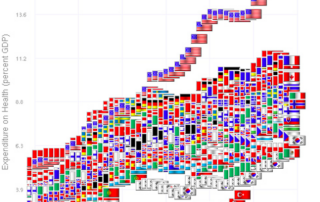
It’s easy for two people to look at the same information – such as this chart (above) about health costs – and perceive totally different things. What I see is an out-of-control Medical Industrial Complex that’s heading, Icarus-like, for collapse. What many designers see is a sea of [continue …]
 Something special is happening in France. A nationwide campaign will be launched next week by the Colibris movement for the 2012 Presidential Elections – but without a charismatic leader.

A splendid new book from Monacelli Press marks the coming of age of urban agriculture – at least for the design world. Carrot City: Creating Places for Urban Agriculture is a timely reflection on design and urban food systems, and on [continue …]
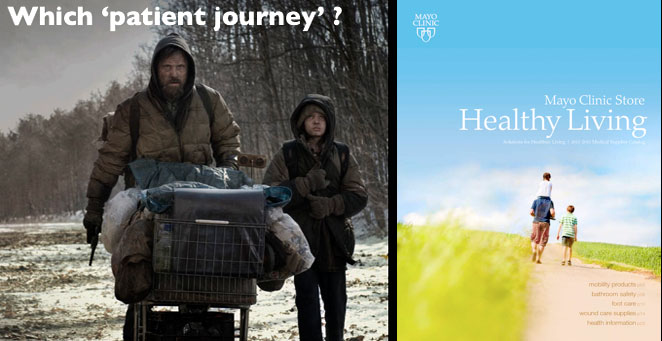
This text touches on: 'energy intensity in health systems' , 'peak fat' , '5% health in Cuba', 'the Quantified Self' , 'Design grammars for health and care' , 'doing what we know we need to do'.
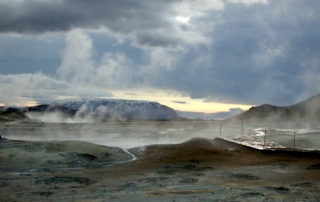
“Who needs oil when you have rain?” The ad for Landsvirkjun, Iceland’s national energy company, dominates this month’s Icelandair magazine. It sits alongside other ads that feature wild spaces, rugged outdoor clothing, and all-round natural purity. The message is not disguised: Iceland is blessed by massive amounts of clean energy.
The [continue …]

A new book by Alex Prud’homme called The Ripple Effect addresses the “vast and desperately serious subject” of water.
The author does not hold back: all the world’s water problems are here. The sewage, fertilizers, industrial chemicals, plastics, paint, drugs, and hand soap, among other [continue …]

When I arrived at Angsbacka, the site in Sweden of last weekend’s first Future Perfect festival, an alarming array of leaflets was on offer in the foyer : ‘Shamanic De-Armouring’; ‘How To UpGreat Your Life’ or ‘Reach The Temple of your Inner Beauty’; [continue …]

The image above is a Piezzoelectric skin that could be attached to vertical surfaces on buildings.The skin would generate electricity as wind moved across its tiny hairs. Wind Skin, as the project is called, so enchanted jurors at last week’s [continue …]

If you’re in Paris before 24 July a spectacular exhibition called The Fertile City: Towards An Urban Nature is well worth a visit.
The show’s OTT poster does not over-promise. The exhibition explores nature in the city from multiple perspectives: historical, social, cultural, botanical, ecological. Two [continue …]
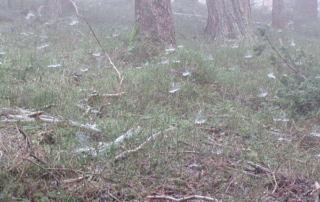
Today seems to be the day when, once a year in this part of France, every spider in the region spins her best possible web at the same moment.
Early in the morning, when covered in dew, the whole landscape seems to be dotted with uncountable millions of these amazing structures.
Now [continue …]

Last week I was taught how to sharpen our kitchen knives by a wood carver, Howard Raybould, who’s been honing his technique for 30 years. It’s the most useful skill I’ve acquired since learning how to ride a bike.
Howard arrived bearing: a wooden board; a [continue …]
The day after I celebrated his Kickstarter success with Tyler Caruso, co-founder of Seeing Green, which is about measuring the value of urban agriculture, I read a fascinating piece by Simon Kuper in the FT about the use of data to analyse every tiny aspect of a [continue …]

When Jimmy Carbone, co-creator of The Good Beer Seal, was considering running for mayor of his old hometown in Haverhill, Massachusetts, he began to ponder possible new uses for industrial buildings that had fallen in to disuse. Could small resource-sharing breweries be a centerpiece of [continue …]
[Stop Press: Polydome has been shortlisted for the 2012 Buckminster Fukller Challenge]
A few years ago urban farming in developed cities was a fringe topic that few designers or architects thought much about. There were exceptions: we tried hard [but failed] to build a prototype of Natalie Jeremijenko’s Urban Space [continue …]
This was a first for me: witnessing first-hand a Kickstarter project cross the line and go live.
The happy guy with the phone [in Claire Hartten’s garden in Brooklyn] is Tyler Caruso, joint founder [with Erik Facteau] of Seeing Green: The Value of Urban Agriculture.
[continue …]

[The following is based on the author’s keynote at the Buckminster Fuller Challenge awards in New York on 8 June. He was also on the 2010 jury of the Challenge.]
We will not transition successfully to a restorative economy until [continue …]
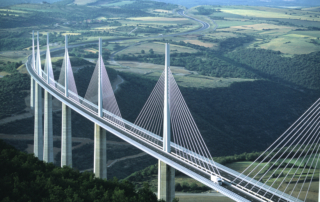
It’s hard not to be impressed by the Millau Viaduct that’s down the road from where I live in France.
The tallest bridge in the world boasts an eight-span steel roadway, is supported supported by seven huge concrete pylons, and weighs 36,000 tonnes.
But consider this: The great pyramid in Egypt weighs [continue …]
JOHNTHACKARA designing for life
© The John Thackara blog and website is licensed under a
Creative Commons Attribution-NonCommercial-NoDerivs 3.0 Unported License.
Permissions beyond the scope of this license may be available at john [at] thackara [d o t com], 1993-2026
