(I changed the title of this post on 15 August) As a punishing heatwave headed for a fourth week here in France, a familiar cry went up from the country’s exhausted citizens: “The government must do something”.
Such cries let off steam, but a reality check is in order. “The government” – in the form of city planners, policy makers and politicians – has not been inactive. In much of Europe, it has followed expert advice to focus on longer-term solutions such as shade, insulation and cooling centres. In South Asia, too, there is consenus four interventions are practical and effective: urban greening, heatwave early warning systems, cool roofs, and shifting work hours.
https://www.downtoearth.org.in/environment/we-survived-the-sun-for-centuries-why-is-it-killing-us-now
Government action to keep us warm dates back 50 years, to the 1970s oil crisis. That’s when European lawmakers first pushed for better housing insulation against cold, and the first meaningful thermal building regulations emerged. But even that work is incomplete, especially for older buildings. And besides: these measures are top-down, expensive – and slow.
The Heating Ventilation and Air Condition (HVAC) industry is especially ill adapted to change. Its army of highly trained technicians install and maintain complex equipment and systems with great efficiciency. Their every action is shaped by regulations and formal certifications. But if we follow the same approach for coolth, an integrated and comprehensive cooling infrastructure will take more decades again to implement.
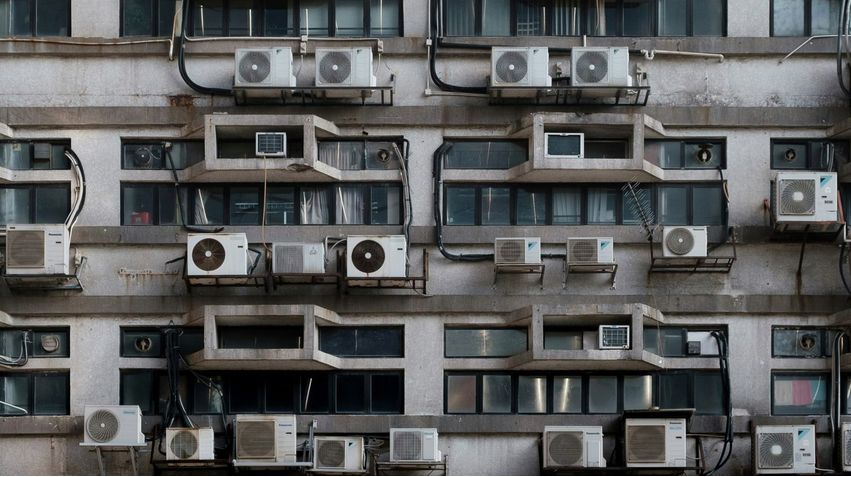
But is that the modern way to go? Although HVAC has been optimised to keep us warm whilst saving energy – the same insulation works like an oven when outside temperatures soar. And even though HVAC is effective at cooling interiors, the heat it extracts from inside buildings is pumped into the streets outside. Public spaces and streets – where billions of poor people work, and often live – get even hotter as a result.
We do not lack for data in deciding what to do. Environmental monitoring is widespread in the world’s cities, and conversations among academics, environmentalists, architects, health experts, and planners are intense, and ongoing. But among citizens? Less so.
Is now a good moment for us to learn from the majority world? Fewer than 15 per cent of the 3.5 billion people who live in high temperatures regions own an air conditioner. The ways they cope in ‘off-grid’ communities are highly nuanced and involve novel use of communal and publicly available resources
[/fusion_text]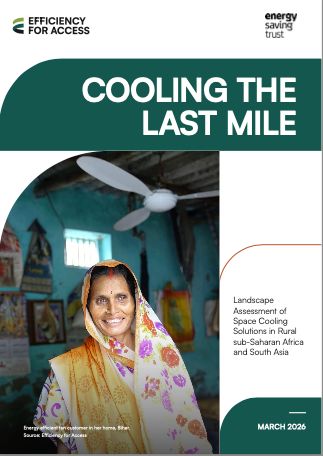
2026-07-06 airco
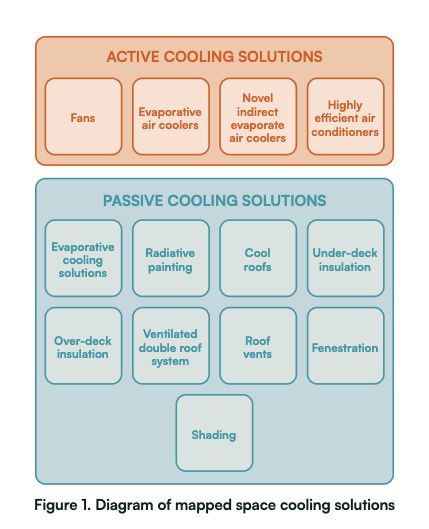
A new report called Cooling The Last Mile maps the landscape of low-cost, low-energy space cooling solutions in use, today, in sub‑Saharan Africa and South Asia. https://efficiencyforaccess.org/wp-content/uploads/Cooling-the-Last-Mile-1.pdf
A new report called Cooling The Last Mile maps the landscape of low-cost, low-energy space cooling solutions in use, today, in sub‑Saharan Africa and South Asia.
Covering both passive and active solutions, the 64 page report follows a 36 month interdisciplinary and comparative study called Cool Infrastructures: Life With Heat in the Off Grid City – a collaboration between research institutions in Scotland, Cameroon, Pakistan, India, Indonesia, France, Germany and Singapore.
The research was commissioned to help women and men in low income urban settlements with partial or limited access to electricity. But some of these solutions – from shading with textiles, to evaporative cooling devices, can be deployed simply and quickly by many of us sweltering today in northern cities, too.
Kris de Decker, editor of Low-Tech Magazine, was the first to spot the potential of removable textile layers to keep homes warm in winter, and cool in summer.
The use of window textiles on a building’s exterior – in the form of an awning which blocks solar heat before it enters through the glazing – can result in a significant decrease in energy consumption – even when AC units are also used inside.
Exterior curtains for cooling predates the use of glass windows by at least 2,000 years, de Decker reminds us. In the Middle East and around the Mediterranean, people used textiles not only to shade unglazed windows and doors, but also roofs, facades, courtyards, and entire streets. In Egypt today, textile furnishings known as “toldos” or “sun sails” are made and installed by residents in a bottom-up movement supported by a local industry of expertise and craftsmanship.
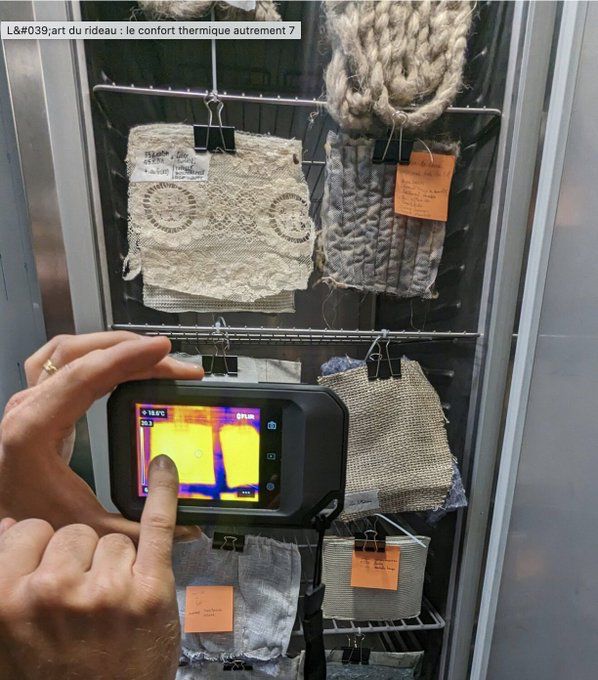
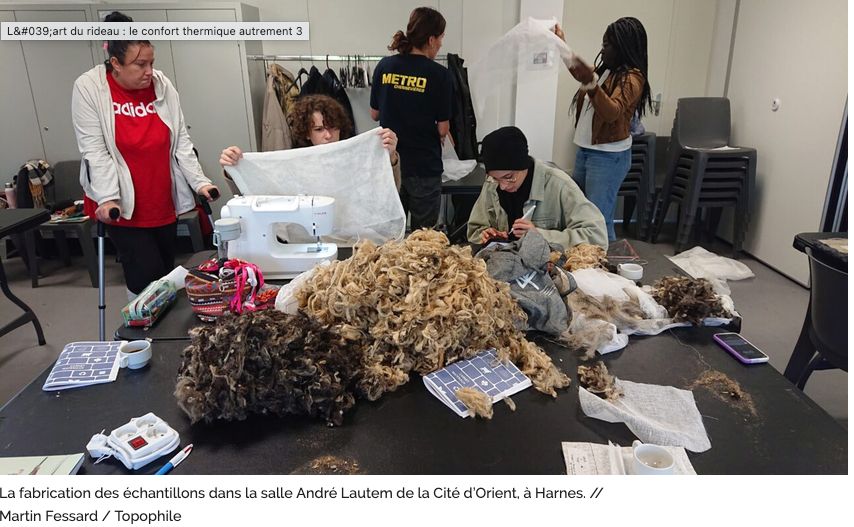
A French designer, Martin Fessard, is taking such textiles to a next level with bio-sourced hygrothermal curtains. These curtains made of linen and recycled cotton to better distribute heat within homes.

.
Inspired by the fact that we have dressed buildings with textiles for 2,000 years, Martin Fessard is now testing what kind of textiles work best today. Shown left: As warm air drifts over fabrics, it can alter its course. (Design: Maud Harou / Topophile)
Design to the coordination rescue?
Until about now, technology roadmaps for low cost cooling have focused on universal, electrically powered consumer appliances – principally, fans and refrigerators. But is the mass deployment of air conditioning units the only option available.
Cooling design must not only be technically feasible, but also socially just, environmentally friendly, inclusive, and economically viable. As Cooling The Last Mile emphasizes, cooling design needs to balance social justice, technical constraints, and economic factors. To achieve that balance, it needs to to be participatory, context‑sensitive, and inclusive.
In that context, cooling is not just about equipment. It’s also about coordination. A constant effort is needed to to balance the availability of material and technology, understand local micro-climates, accomodate cultural expectations, negotiate withindividual and collective behaviours – and do all that for a fraction of the cost of high-tech cooling.
Finance will be crucial, too, of course. Government officials have important roles to play in the creation inclusive loan and subsidy schemes. But tomorrow’s solutions need to be co‑developed with communities, not imposed on them from outside. They also need to minimise lifecycle emissions and waste, prioritise locally available and regenerative materials, and integrate a combination of passive and active solutions based on local – and imported – knowledge.
Some solutions familiar on one location have potential to be tried in other geographies. The report mentions, the use of mosaics as a radiant barrier in India. And evaporative coolers, now widely available in on‑grid settings in South Asia, have potential for uptake in off‑grid hot‑dry regions, too.
“Tailored, context-specific solutions – aligned with local conditions, infrastructure, financial resources and community needs – are essential” the report states.
Local masons, carpenters, fabricators, and architects need to be trained to integrate passive and active cooling into rural housing, schools, and healthcare facilities.
The value brought by for designers, in this complex space, is probably more to coordinate, than execute.

.
The Global Health Information Network has published this Call. It invites people living in contexts of urban poverty to submit practices that meet their needs for cool, heat, food, water and space.